
In this field note
An erector trial on perfect sample blanks can miss the material variation that stops production later. Select the machine around the actual case style and board supply, and agree how the erected case will be inspected before asking for a speed demonstration.

A case erector opens and forms supplied corrugated blanks; its input is part of the application. Give the supplier controlled drawings plus representative physical lots, then inspect separation, opening, flap alignment and squareness at discharge. The records below help define that trial without inventing minimum sizes, board tolerances or guaranteed rates.
Define the case before selecting the erector
Confirm the case style, not just its length, width and height. Wexxar’s Case & Tray Forming 101 describes different forming approaches for regular slotted cases, Bliss boxes and trays. A supplier’s ability to form one construction does not establish compatibility with another.
| Input or item | Value or source | Why it matters |
|---|---|---|
| Case style and closure | Approved blank drawing | Defines how the case opens and closes |
| Dimensions and tolerances | Controlled specification, with measurement convention | Allows the actual range to be assessed |
| Board and scores | Converter specification and samples | Defines the material and folding behaviour |
| Blank supply | Lot, storage history and observed condition | Preserves what was demonstrated |
| Required output | Case loading and bottom-closure requirements | Defines the discharge acceptance task |
Include the widest and narrowest relevant constructions and the transitions that matter to production. Let the supplier identify unsupported combinations rather than assuming that independent maximum dimensions can be combined into one permissible box.
Include variation from the real board supply
Wexxar identifies scoring, material type, material age and box design as factors affecting forming. Its guide also notes changes in corrugated behaviour under dry and wet conditions. This supports a representative sampling approach; it does not provide a universal humidity limit or prove that one mechanism will handle every blank.
Create a sample matrix with the converter. Include normal production lots and any documented problem material you want the system to address. Do not damage blanks artificially and then treat the outcome as a production failure-rate estimate.
| Sample reference | Style / drawing | Lot and condition | Reason for inclusion | Result reference |
|---|---|---|---|---|
| ___ | ___ | ___ | Main production case | ___ |
| ___ | ___ | ___ | Relevant size or score variation | ___ |
| ___ | ___ | ___ | Documented difficult incoming lot | ___ |
| ___ | ___ | ___ | Next-format transition | ___ |
Inspect the case where loading receives it
Judge the formed output at a defined location. Opening a blank successfully is only part of the task if the case later twists, loses alignment or presents a poor bottom to the loading station.

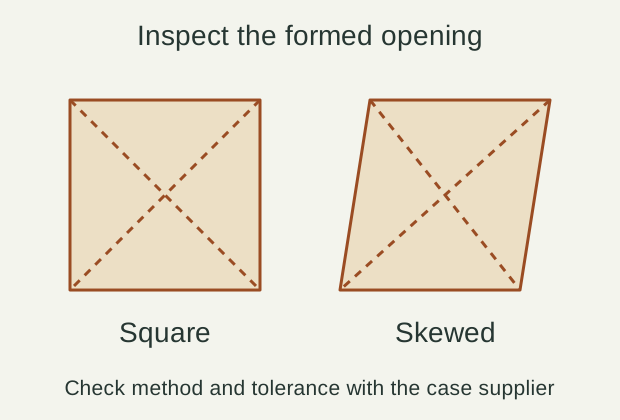
Check squareness using the measurement convention and tolerance agreed with the case supplier and project team. Comparing top-view diagonals can help reveal skew, but equal diagonals alone do not establish every dimensional or flap condition. Record the full inspection rather than replacing it with a single “square” checkbox.
| Observation | Record | Agree before the trial |
|---|---|---|
| Separation | Doubles, missed blanks and interruptions | What counts as an intervention |
| Opening | Incomplete opening or damaged panels | Accepted condition and retained sample rule |
| Squareness | Measurement points and observed result | Inspection method and allowable deviation |
| Flap alignment | Overlap, gap or interference | Case specification |
| Bottom closure | Tape or glue result, if included | Closure acceptance method |
| Discharge | Case orientation and receiving stability | Handoff point and support arrangement |
Check changeover and replenishment too
A selection trial should include the work that happens between successful cycles. Record magazine loading, replenishment and at least the relevant format transition under the supplier’s approved procedures. Keep normal replenishment separate from fault recovery in the observation log.
Ask which adjustments require a part change, which use retained settings and how an operator confirms the next case is ready. An empty magazine or an unprepared blank supply can interrupt output even when opening mechanics perform well. Assign responsibility for those inputs in the project scope.
If the supplier demonstration omits bottom sealing or uses a separate downstream unit, carry that exclusion into the comparison. The case-packer cost worksheet provides a scope record so a forming module is not confused with a complete case-handling project.
Methods and sources
This selection guide uses Wexxar’s published Case & Tray Forming 101 and Flex E Pack catalog for case styles, material variation and forming/packing/sealing boundaries. The diagonal illustration and acceptance tables are editorial inspection proposals, not a published tolerance standard. Older source material is used for these physical distinctions; current model capability still requires current supplier confirmation. Source files were retrieved on 16 October 2026. Return to case erectors for the input-selection context.
Source documents read:
- Case & Tray Forming 101 (retrieved 16 October 2026).
- Flex E Pack catalog (retrieved 16 October 2026).